
Linking History and the Future
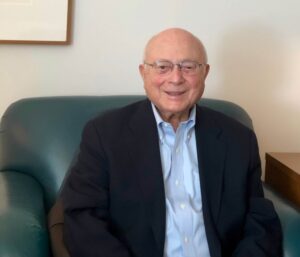
Psychoanalysts and psychotherapists may gather in other places, but for psychiatrist Robert Fajardo nowhere else is quite like the Chicago Psychoanalytic Institute.
Fajardo says he joined the Franz Alexander Society as a way to invest in the “collaborating kind of atmosphere” that has sustained him since he became a student at the Institute in 1970.
Fajardo still recalls the conversation at University of California San Francisco School of Medicine in which a mentor, Norman Reider, suggested he go to Chicago for training. Reider told Fajardo he would like the Chicago Institute because, in spite of differing paradigms, varied perspectives, and divergent personalities, it was a psychoanalytic center with a fair amount of collaboration. Fajardo says Reider’s insight was a worthy one that still holds true today: “I find this to be a hospitable and diverse learning institution.”
Case in point: in the 1980s, Fajardo’s late wife Barbara was in the forefront of lobbying the Institute to allow practitioners with PhDs to train as analysts. It was different from his earlier experience; “I had been trained ‘MD, MD, MD,’” he says. But the Institute and field not only survived the controversy, they have thrived with the inclusion of differently-degreed professionals.
Members of the Institute also come together to take care of each other. When Barbara Fajardo grew sick and later passed away as a result of uterine cancer, her wariness of the analyst assistance committee at the time led him to subsequently become involved with their work. Today, he serves as chair of the Joint Psychoanalyst Assistance Committee.
Thinking about the future, Fajardo says he imagines the discipline will continue to evolve. “Psychoanalysis is not a fixed and stationary process,” he says. He anticipates the faculty will continue to develop their own many perspectives, while maintaining collaboration all the while.
Making that future a bit more assured is the reason he encourages others to join him in becoming members of the Franz Alexander Legacy Society. “Many of us often just don’t think about it,” he says. “It’s important to be respectful to our family, but also to assist the Institute that has given, and continues to give, each of us so much.”
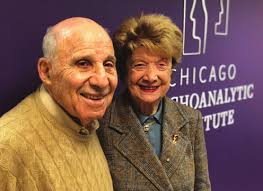
Former board chair and current board member Eva Lichtenberg, a clinical psychologist, says she might have become an analyst herself if the profession had opened to non-MDs sooner.
“With my family income and background, medical school wasn’t in the cards,” Lichtenberg, 85, recalls. She and her family arrived in Chicago in 1941 from Czechoslovakia via Japan as Jewish refugees. Scholarships covered the cost of her education but not living costs. She calculated that she could work as a teaching assistant while earning her PhD in psychology, unlike in a medical doctor program.
The year she applied, University of Chicago’s psychology department accepted 17 students: “Two were women and the rest were men. They told me, ‘you’re taking the place of a man… you’re going to get married, stop working and waste a place.’ I said, ‘I’m qualified. Let that be my problem.”
Lichtenberg did marry—her husband was a successful businessman who “could make 5 out of 2 and 2—legally,” she jokes—and had a son. She started her still-running private practice as her son grew up (After her first husband passed away more than 30 years ago, she met and married Institute faculty member Arnold Tobin).
“But one thing people worry about is ‘will I have enough money left to take care of myself until the end of my life?’ With planned giving … that’s not an issue,” Lichtenberg says.
Initially, she gave as a board member and leader. But she continues to enjoy the programs of the Institute, such as continuing education and to support the mission of sustaining psychoanalysis as a clinical practice and a theory of mind.
“People take it for granted, but psychoanalysis is the trunk of the tree from which virtually all other therapy models branch off,” Lichtenberg says. But, psychoanalysis is also important for the way it is taught across a range of disciplines, she adds: “Our whole discourse about people, movies, theatre, music has been changed and made more understandable by psychoanalytic thinking.”